FAQ's:
DEFINITION
OF TERMS:
Accrual
Method |
- |
A
method for the valuation
of fixed income funds
which calculates Net
Asset Value (NAV) using
the assets’ purchase
or cost price. Returns
on the Fund are from
the amortization of
the bond cost and the
accrual of interest
on the securities comprising
the portfolio. This
method disregards changes
in the prices of the
underlying securities.
The accrual method is
distinguished from the
marked to market method
which values the fund’s
securities at the current
market price. |
Active
Management |
- |
Refers
to a style of investment
management that seeks
to attain returns above
a set benchmark or standard
by making more active
adjustments to the various
types of assets and
securities within an
asset class to take
advantage of expected
price movements. This
is compared to a more
passive type of management
where a “buy-and-hold
strategy” is employed
or where the fund manager
buys assets that seeks
to mirror the composition
and return of a desired
benchmark. |
Annualized
Return |
- |
The
value that an investment
has achieved over a
12-month period. |
Bond |
- |
A
certificate of indebtedness
issued by a corporation
or government, with
a stated interest rate
and fixed due dates
when interest and principal
must be paid. |
Coupon |
- |
The
current interest rate
for a fixed income security. |
Cut-off
time |
- |
The
latest time by which
subscriptions or redemptions
to a fund utilize the
applicable NAVPU. Subscriptions
or redemptions after
the cut-off time will
acquire the NAVPU of
the next applicable
banking day. |
Duration |
- |
Also
known as Macaulay duration,
is the weighted average
time to receipt of the
present value of the
cashflows from a bond.
This is a tool used
to determine the risk
in a bond (see Modified
Duration). |
Early
Redemption Penalty |
- |
This
is the extra cost charged
to the investor for
redeeming units of a
fund before the Minimum
Holding Period has elapsed. |
Equity |
- |
Considered
as a one of the general
asset classes in an
investment portfolio,
distinguished from fixed
income assets. Equity
represents ownership
in a corporation, and
represents a claim on
the proportionate share
of the corporation’s
assets and profits. |
Explanatory
Memorandum |
- |
Document
which contains the summary
of the UITF’s
Plan Rules and Regulations,
and the terms and conditions
governing the investments
of the UITFs. |
Fixed
Income |
- |
One
of the general asset
classes in an investment
portfolio, distinguished
from equities. Fixed
Income securities have
a stated return and
maturity value. Examples
of fixed income assets
are bonds, loans, and
deposits. |
Fund
Manager |
- |
The
person or entity responsible
for determining the
composition, changes,
and movements of the
fund’s portfolio,
in order to optimize
fund performance while
controlling the risk
of the portfolio. |
Fund
Structure |
- |
Refers
to the regulatory structure
that governs the investment
fund. In the Philippines,
there are currently
3 types of fund structures,
mutual funds, common
trust funds (CTF) and
unit investment trust
funds (UITF). |
Fundamental
Analysis |
- |
Is
a method used to determine
the value of a financial
instrument by analyzing
the economic, political,
environmental and other
relevant factors affecting
the supply and demand
for that instrument.
For equity investments,
the company’s
financial situation,
business prospects and
profitability are some
of the factors analyzed.
For fixed income investments,
the credit risk of the
issuer and its yield
relative to market interest
rates are studied. Fundamental
analysis is contrasted
from technical analysis
which focuses on analyzing
price movements by identifying
price chart patterns. |
Index |
- |
An
index is a collection
of selected securities
which is used as a representation
of the general characteristics
and performance of a
particular market. |
Investment
Grade |
- |
Refers
to bonds judged likely
to meet payment obligations
which are deemed suitable
for conservative investors.
These bonds have ratings
of at least Baa3 from
Moody’s or at
least BBB- from Standard
& Poor’s. |
Launch
Date |
- |
The
specific date wherein
a new product is introduced
to the public. |
Marked-to-Market
(MTM) method |
- |
A
vauation method where
assets of the Fund are
valued at the current
market price, taking
into account unrealized
capital gains or losses.
This is the international
standard used to value
the assets of both equity
and fixed-income funds. |
Maturity |
- |
The
date on which a loan,
bond, mortgage, or other
debt or security is
due to be repaid. |
Minimum
Additional Participation
Amount |
- |
This
is the smallest additional
amount an existing investor
can invest into the
fund. |
Minimum
Holding Period |
- |
The
minimum number of days
that an investor must
keep his investment
in the fund before he
can redeem it without
penalty. |
Minimum
Participation Amount |
- |
This
is the smallest amount
which must be invested
in a fund. |
Minimum
Redemption Amount |
- |
This
is the smallest amount
that an investor can
redeem out of his investment
in a fund. |
Modified
Duration |
- |
This
is an estimate of how
the price of a bond
will change for a given
change in yield. The
higher the modified
duration of a security,
the higher its price
sensitivity to interest
rate movements. |
Money
Market Instrument |
- |
Fixed
income security with
a maturity of less than
one year. |
Mutual
Fund |
- |
A
Mutual Fund is an investment
vehicle managed by an
Investment Company (IC)
that pools money of
shareholders in the
Fund. The money is invested
in a single portfolio
comprised of stocks,
bonds, and other securities. |
Net
Asset Value (NAV) |
- |
The
net worth of the assets
of a Fund. NAV is calculated
by subtracting the Management
Fee of the Fund plus
other Expenses and Liabilities,
from the Total Asset
Value, which is the
current market value
of all the securities
and holdings that comprise
the Fund Portfolio.
NAV = Total Asset Value
– (Management
Fee + Other Expenses
and Liabilities) |
Net
Asset Value Per Share |
- |
The
current worth of a Share
in a Mutual Fund. NAVPS
is computed by dividing
the current NAV of a
Fund by the total number
of Units of Participation
held by investors. |
Net
Asset Value Per Unit |
- |
The
current worth of a Unit
of Participation in
a Unit Investment Trust
Fund (UITF). NAVPU is
computed by dividing
the current NAV of a
Fund by the total number
of Units of Participation
held by investors. |
Passive
Management |
- |
Refers
to a style of investment
management that seeks
to achieve performance
equal to the market
or index returns. |
Portfolio |
- |
An
investor's collection
of investment holdings,
usually with reference
to its composition.
It may be a mix of different
classes of securities,
such as bonds, property,
shares, and cash. |
Redemption |
- |
The
process of selling back
one’s Units of
Participation/Shares
in the Fund. This is
done at the applicable
NAVPU / NAVPS on the
day the Redemption Order
is submitted by the
Investor. The order
must be received by
the Trustee on or before
the Cut off Time for
the day; otherwise,
the transaction will
be processed on the
next banking day. |
Redemption
Notice Period |
- |
Redemption
Notice Period refers
to the number of days
after redemption before
the proceeds are given
to the investor. For
instance, if the redemption
notice period for a
Fund is 4 banking days,
this means that if the
client redeems by the
redemption cut-off time
today (Trade Date),
the redemption proceeds
will be given to the
investor on the fourth
banking day from now,
counting today (Trade
Date + 3). |
Reserves |
- |
Also
known as legal reserves,
it is a percentage of
the value of Common
Trust Funds (CTFs) that
must be set aside for
liquidity purposes,
as mandated by the Bangko
Sentral ng Pilipinas.
Unit Investment Trust
Funds (UITFs) have no
legal reserve requirement. |
Return |
- |
The
sum of interest, principal
payments, reinvestment
income, and any realized
and unrealized capital
gains or losses expressed
as a percentage of principal
in annual terms. |
Risk |
- |
The
possibility of loss
on an investment. Investments
with greater risk must
provide higher expected
returns to be attractive
to investors. |
Risk
Management |
- |
The
process of monitoring
and controlling various
risk factors in an investment
portfolio to ensure
that there are no unwanted
or unintended risks
in the portfolio that
could cause performance
surprises. |
Stocks |
- |
Also
known as shares of a
company, it is a certification
of ownership of a fraction
of the company. These
are the specific securities
traded in the equity
markets. |
Subscription |
- |
The
process by which Units
of Participation of
a Fund are purchased. |
Technical
Analysis |
- |
It
is an approach to the
analysis of price movements
of financial instruments
and their future trends.
It examines the technical
factors of market activity,
often represented by
charting patterns, as
contrasted with fundamental
analysis. Technical
analysts normally examine
patterns of price change,
rates of change, and
changes in volume of
transactions, in the
hope of being able to
predict and profit from
expected future trends. |
Trustee |
- |
The
entity authorized to
hold the assets of a
fund for the benefit
of the beneficiaries
or participants. |
Unit
Investment Trust Fund
(UITF) |
- |
Is
a trust product that
pools the money of various
investors into a single
portfolio managed by
a professional investments
team. The UITF allows
the investor to own
participation in a diversified
portfolio of stocks
or bonds through ownership
in units of the fund. |
Valuation
of the fund |
- |
This
refers to the method
used in order to calculate
the Net Asset Value
of the securities. The
two commonly practiced
methods are the Accrual
Method and the Marked-to-market
method. |
Volatility |
- |
It
is how much variability
there is in the price
changes of the investment.
The more variability
there is, the higher
the volatility. |
Yield
to Maturity |
- |
The
percentage rate of return
earned on a fixed income
security assuming it
is held to its maturity
date. It assumes that
coupon interest paid
over the life of the
security is reinvested
at the same rate. |
| Q. |
What
is a fund? |
| A. |
A
fund, also known as an
investment fund, is a
collection of stocks,
bonds or other securities
owned by a group of investors
and managed by a professional
investment company. |
| |
|
| Q. |
What
is a UITF? |
| A. |
Similar
to a Common Trust Fund
(CTF), a Unit Investment
Trust Fund (UITF) is a
trust product that pools
the money of various investors
into a single portfolio
managed by a professional
investments team of a
trust department of a
bank or an institution
with a trust license.
The Fund allows the investor
to own participation in
stocks or bonds at a fraction
of the costs and minimum
investment amounts usually
associated with these
investments. Moreover,
the investor need not
track his investment daily,
nor worry about what stocks
or bonds to buy or sell.
This is because skilled
fund managers with years
of asset management experience
handle the portfolio day-in,
day-out. But unlike the
CTF, a UITF must be valued
using the marked-to-market
method and is not required
to keep any reserves with
the Bangko Sentral ng
Pilipinas. |
| |
|
| Q. |
What
is a Mutual Fund? |
| A. |
A
Mutual Fund is an investment
vehicle managed by an
Investment Company (IC)
that pools money of shareholders
in the Fund. The money
is invested in a single
portfolio comprised of
stocks, bonds, and other
securities. |
| |
|
| Q. |
What
are the differences between
a Mutual Fund and a UITF? |
| A. |
| |
UITF |
Mutual
Fund |
Management |
The Trust Department
of a Bank |
Investment
Company |
Participation |
Units of Participation |
Shares
in the mutual Fund
Company |
Regulator |
BSP |
SEC |
Valuation
Method |
MTM |
Accrual
or MTM |
Reserves |
None |
None,
but requires IC
P50 M paid-up capital |
Taxes |
None |
Doc
Stamps of P1 per
P200 par value |
Sales
License |
Standardized
training from TOAP-accredited
trainor |
Agents
need SEC license
to sell Fund |
|
| |
|
| Q. |
Why
should I invest in a fund? |
| A. |
There
are several reasons why
it would be wise to invest
in a fund rather than in
securities directly.
• |
Professionally Managed:
The fund is constantly
monitored by a team
of professional
investors, making
adjustments in order
to seek out the
fund's best possible
performance. Not
only is the investor
relieved of the
burden of constantly
researching and
monitoring the securities,
but also, this responsibility
falls on a fund
manager or a team
whose full time
job is to manage
the fund. These
managers come with
a wealth of training
and experience under
their belts. |
• |
Diversification:
A fund is typically
invested in hundreds
or even thousands
of different securities.
No more than 10%
of its assets can
be invested in a
single security,
except for government
securities. This
diversification
spreads the risks
over a broad base
thereby limiting
potential loss. |
• |
Affordability: A
fund pools together
the resources of
many small investors
so as to create
greater buying power
than they could
achieve by themselves.
In addition, economies
of scale come in
because funds purchase
large volumes of
a specific security
and thus, are able
to spread some of
the costs like commissions
and processing fees
over many investors.
In essence, an investor
is buying shares
or units of participation
in the fund. Also,
funds allow investors
to gradually add to their investments
over time. |
• |
Liquidity: Also,
a fund gives investors
greater liquidity
than do stocks or
bond. You can purchase
or redeem your shares
on any business
day. |
|
| |
|
| Q. |
What
are the risks involved in
investing? |
| A. |
| A. |
Market
risk |
- |
is the danger associated
with unpredictable
events that influence
the performance
of the entire market.
Examples of this
include economic
recessions, natural
calamities, and
political scandals.
This type of risk
cannot be diversified
out of an investment
portfolio, for it
affects most or
all securities in
the market. |
| B. |
Credit
risk |
- |
refers to the possibility
a debtor will default
on a loan. This
non-payment of the
principal usually
happens in fixed-income
instruments. Investing
in bonds with a
high credit rating
minimizes this risk;
keeping a portfolio
well-diversified
also helps. |
| C. |
Value
of the fund may
go up or down |
- |
Returns and performance
of the fund are
not guaranteed,
therefore the investment
is subject to possible
loss of principal.
Even if the Unit
Trust Fund has provided
high returns in
the past, historical
performance of the
Fund is no guarantee
of its future performance. |
| D. |
Not
covered by the PDIC |
- |
Unlike Bank Deposits,
which are insured
up to P250,000 by
the Philippine Deposit
Insurance Commission
(PDIC), an investment
in a UITF is uninsured.
This is because
investment in the
UITF is not considered
a deposit with the
Bank. |
|
| |
|
| Q. |
How
is the fund's risk and return
determined? |
| A. |
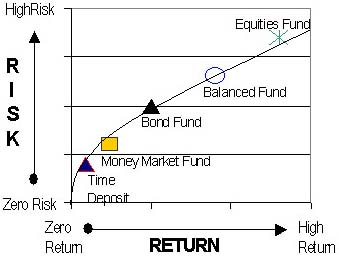
The
risk and return of the
Fund is determined in
large part by the asset
type or types that comprise
it. To illustrate, the
graph to the right plots
the quantified risk and
return characteristics
of the various types of
Funds over a span of five
years. Portfolios invested
purely in cash or time
deposits would generally
have the least exposure
to risk, as well as the
least return. On the other
end of the spectrum, portfolios
with holdings composed
entirely of equities is
high-risk, yet high return.
A curve called the risk-return
frontier may be used to
approximate the trade-off
between risk and return. |
| |
|
| Q. |
What
are the different kinds
of investment funds? What
are their differences? |
| A. |
| A. |
Money
Market Fund |
- |
These funds invest
in short-term debt
securities, which
are fixed income
instruments with
remaining lifetime
of less than a year.
Such securities
a generally stable
asset valuation
given that they
are close to maturity.
The return objective
of these low risk,
low return funds
is usually to perform
better than the
short-term time
deposit rates in
the market. |
| B. |
Equity
Fund |
- |
These funds are
invested in stocks.
Stocks are shares
of ownership in
a company issued
for the purpose
of raising capital.
They have a tendency
to be volatile,
with valuations
changing considerably
along with company
developments and
market events. However,
the returns on these
investments, comprised
of both dividends
and capital gains,
are consistently
high in the long
run. Equity funds
aim to achieve capital
growth over a long
period of time.
These funds provide the potential for
high returns but
with it comes more
volatility or risk. |
| C. |
Fixed
Income (Bond) Funds |
- |
These funds are
invested in fixed
income instruments.
Issued by governments
and corporations
to borrow capital,
they are called
"fixed income"
because they are
obligations to repay
fixed amounts of
interest, plus the
principal, in the
future. Since the
interest returns
on these instruments
are preset, these
securities are less
risky than stocks.
These funds are
conservatively managed
than equity funds,
and are less subject
to variability in
returns. The objective
is often to preserve
capital while producing
a moderate income
by investing in
medium to long-term
bonds or fixed income
securities issued
by the government
or corporations. |
| D. |
Balanced
Fund |
- |
are invested in
a mix of equities
and debt. They combine
the growth potential
of higher-risk stocks
with the less volatile
returns of fixed-income
securities. Their
risk-return characteristics
fall between Equity
Funds and Fixed-Income
Funds. |
|
| |
|
| Q. |
What
are open-end and closed-end
funds? |
| A. |
Open-end funds sell as
many units as investors
are willing to buy. This
makes the fund grow bigger
as every new investor
buys a unit of the fund.
Closed-end funds sell
only a fixed number of
shares. After that, the
shares are traded on an
exchange. |
| |
|
| Q. |
What
type of fund is best for
an investor? |
| A. |
Different types of funds
have different objectives.
So an investor should
choose the fund which
satisfies his own needs
or preferences.
a. Investment
Objective
• |
Capital Growth -
some funds are focused
on giving higher
returns. These funds
are typically riskier
than capital preservation
funds. |
• |
Capital Preservation
- some funds are
aimed at maintaining
the investor's invested
capital, usually
offering smaller
returns at a lower
risk. |
b. Time horizon
• |
Another key characteristic
would be how long
the investor can
afford to leave
his money untouched
in the investment.
This affects considerably
how much risk or
volatility the investor
can handle. Generally,
the longer the acceptable
time horizon, the
greater the tolerance
for risk. |
c. Risk profile
• |
Risk-seeker - the
investor prefers
investment instruments
with high returns
even if these vary
wildly from period
to period. |
• |
Risk-averse - the
investor may opt
for stable, predictable
performance despite
returns that are
generally lower. |
Example:
An investor wishes to
build a vacation house
for his retirement in
ten years. He can afford
to keep the money allotted
for this locked up for
the entire period, and
he can tolerate up to
moderate risk if his money
can appreciate considerably.
Given these characteristics,
he may want a fund that
delivers capital growth.
Towards
this objective, he may
prefer an equity fund.
Equities provide generally
higher growth over debt
instruments, in exchange
for a higher risk exposure.
However, even as they
are more volatile than
other instruments, returns
on equities tend to average
out in the long-term.
An investor willing to
wait out a ten to fifteen
year time frame will have
the advantage of a greater
probability of high returns
at low level of risk. |
| |
|
| Q. |
How
do you invest in a fund? |
| A. |
In order to invest in
a fund, a person must
buy shares or units of
participation in the fund.
The value of one unit
can be calculated by dividing
the current market value
of the entire fund by
the number of outstanding
units. The market value
of the entire fund is
equal to the market value
of all the securities
in the fund. This is known
as Net Asset Value or
NAV. By dividing the NAV
by the number of outstanding
units, we get the NAV
per unit of participation
or NAVPU. The NAVPU is
the price the investor
must pay for one share
or unit of participation.
NAVPU = Total Assets
of the Fund - (Management
Fee + Other Expenses and
Liabilities)
Outstanding
Number of Units of the
Fund |
| |
|
| Q. |
When
are Net Asset Values calculated?
Would I know my Net Asset
Value per Share/Unit before
I invest? |
| A. |
The fund's Net Asset Value
per Unit/Share is calculated
at the end of the day.
This means that if an
investor is able to buy
into the fund before the
cut-off time for the day,
he will only find out
his Net Asset Value per
Unit/Share the following
day. |
| |
|
| Q. |
How
is the fund valued? |
| A. |
There are two ways to value
fixed income funds, the
accrual method and the marked-to-market
method.
In
the accrual method the
value of each asset in
the Fund is recorded at
its purchase price and
coupon payments are accrued
or accumulated on a daily
basis(less tax expenses).
Take note that this does
not reflect the actual
market prices at which
assets in the Fund can
be traded.
On
the other hand, the marked-to-market
method values each security
in the portfolio at its
end-of-day market price
plus the accrued interest
(less taxes and fund expenses)
For
example:
• Take a portfolio
made up of two bonds:
o BOND
A maturing in 28 years
o BOND
B maturing in 8 years
• Both are purchased
on Jan. 1, 2005 at $103.
• Suppose that on
Nov. 5, 2005:
o BOND
A has a market price of
$114, with accrued interest
of $10
o BOND
B has a market price of
$106 and accrued interest
of $8.
•
Under the accrual method,
you would take the purchase
cost of each:
o $103
for BOND A and $103 for
BOND B
o and
simply add the accrued
interest for a total NAV
of $224 (224=103+103+10+8).
•
Under the marked-to-market
method, you must use current
market prices
o $114
for BOND A and $106 for
BOND B
o And
again add accrued interest
to give a NAV of $238
(238=114+106+10+8).
MTM
accounts for all gains
and losses of the assets
of the Fund on a daily basis. Thus, it reflects
the actual net worth of
the Fund
1. |
when the market
is up, you can realize
the full gains; |
2. |
when the market
is down, you can
buy at market value,
reaping potentially
higher gains than
you would under
accrual valuation
should the market
come back up; and. |
3. |
you know how much
your investment
in the Fund is really
worth, thanks to
a transparent fund
accounting method
that is the convention
for investment-managed
Funds worldwide. |
|
| |
|
| Q. |
How
do I earn from my investment
fund? |
| A. |
Recall that when purchasing
units of participation/shares,
the price of each unit
is determined by the current
day's Net Asset Value.
When redeeming units,
the amount that the investor
shall receive is also
based to the current day's
Net Asset Value. So an
investor can earn on a
UITF when the redemption
price is greater than
the subscription price. |
| |
|
| Q. |
How
can I monitor the fund's
performance? |
| A. |
Prudentialife Optima Funds
sends the following to the
investors:
1. |
Daily Rates. This
is sent to all investors
via e-mail every
morning of a banking
day. This contains
the Net Asset Values
per Unit (for UITF)
and Net Asset Value
per Share (for Mutual
Fund) of the previous
banking day. |
2. |
Daily Update. This
is sent to investors
every afternoon
of a banking day.
This contains the
events explaining
the movements of
the Net Asset Value
Of the previous
banking day. |
3. |
Fund Holdings. This
is sent to all investors
every month and
contains the securities
where the Funds
are invested in. |
4. |
Fund Ranking. This
is sent to all investors
every month and
contains the ranking
of Prudentialife
Optima Funds relative
to similar funds
in the industry. |
5. |
Quarter Reports.
This is sent to
all investors every
quarter and contains
historical financial
information of Prudentialife
Optima Funds as
well as the Investment’s
Manager’s
comments on what
to expect on the
following quarter.
This is sent to
all investors through
mail. |
The above reports can also
be viewed and downloaded
from the website: http://optima.prudentialife.com. |
| |
|
| Q. |
When
does the investment mature?
(No specified tenor - vs.
a fixed tenor of most fixed
income instruments)? |
| A. |
You need to build on the
concept of an "expected
time horizon" for
funds, long term investing/holding
capacity with flexibility
to pay-out.
a. |
For the UITF and
Mutual Funds, no
exact time horizon
exists, but one
can maximize benefits
and minimize risks
of investing in
a fund when staying
medium to long term
(at least 3-5 years). |
b. |
Also, the funds
feature the flexibility
to exit the investment
any time, should
the investor require
to do so. |
|
| |
|
| Q. |
When
would be a good time to
invest? |
| A. |
One can never time the
market; investing should
involve a disciplined
process.
Market Timing is an investment
strategy that seeks to
place the purchase of
investment instruments
on the time that prices
are low so that when prices
go up, the instruments
bought can be sold for
higher prices and thus
the investor can earn
from the sale. The ultimate
goal then for timing the
market is to gain the
maximum return by buying
at the absolute bottom
of the instrument's price
and sell at the very peak.
That is why the biggest
fear of investors is to
enter the market is when
prices are high and expected
returns are lower.
Consider three investors
John, Jack, and Joe, who
invest in a fund invested
in US Dollar denominated
fixed income bonds issued
by the Philippine government.
Suppose now that each
of the investor buys $5,000
to invest at the start
of each year for 10 years;
the only difference is
the time that each investor
enters the market. John
times the market perfectly
and enters the market
at its bottom, i.e. when
prices are low. Jack meanwhile,
is a periodic investor
who places his investment
on the first business
day of the year. Lastly,
Joe times the market in
the worst possible way
and invests at the peak
of the market, i.e. the
prices are high.
The
following table shows
the investment transactions
and the returns for each
year of each investor.
| |
| |
John's Investment |
(Lowest of Year) |
|
Jack's Investment |
(Start of Year) |
|
Joe's Investment |
(Highest of Year) |
(Highest of Year) |
| |
|
|
|
|
|
|
|
|
|
| |
Value as of End of Year |
Return YoY |
Price per Share* |
Value as of End of Year |
Return YoY |
Price per Share* |
Value as of End of Year |
Return YoY |
Price per Share* |
|
1991 |
2,107.45 |
7,226.82 |
44.54% |
2,107.45 |
7,226.82 |
44.54% |
3,385.98 |
4,498.00 |
-10.04% |
|
1992 |
2,919.13 |
13,863.13 |
13.38% |
3,046.03 |
13,620.99 |
11.40% |
3,720.03 |
9,571.81 |
0.78% |
|
1993 |
3,287.51 |
30,855.12 |
63.57% |
3,393.35 |
30,201.32 |
62.19% |
5,533.46 |
20,497.56 |
40.67% |
|
1994 |
4,436.02 |
30,721.78 |
-14.32% |
5,503.66 |
29,182.17 |
-17.10% |
5,707.51 |
20,989.63 |
-17.68% |
|
1995 |
4,439.87 |
44,675.45 |
28.07% |
4,562.58 |
42,585.19 |
24.58% |
5,684.20 |
31,149.52 |
19.85% |
|
1996 |
5,684.20 |
61,858.11 |
24.52% |
5,684.20 |
59,285.22 |
24.52% |
7,079.94 |
43,787.58 |
21.13% |
|
1997 |
7,078.22 |
100,196.76 |
49.86% |
7,078.22 |
96,295.94 |
49.86% |
10,607.76 |
70,622.16 |
44.75% |
|
1998 |
10,162.32 |
109,517.72 |
4.11% |
10,607.76 |
105,237.43 |
3.89% |
11,850.41 |
78,019.96 |
3.17% |
|
1999 |
11,020.52 |
138,513.23 |
20.95% |
11,020.52 |
133,336.07 |
20.95% |
13,392.91 |
99,344.30 |
19.66% |
|
2000 |
13,329.71 |
178,418.96 |
24.32% |
13,329.71 |
171,982.60 |
24.32% |
16,653.33 |
128,482.65 |
23.13% |
|
Rate of return (annualized) |
|
|
28.11% |
|
|
24.38% |
|
|
15.85% |
|
* Share
Prices are based on the
Salomon Brothers Brady
Bonds- Phill.
From their investments,
John gets the highest
rate of return while Jack,
who trails only by 0.73%
behind John, receives
the second highest return.
Joe's investment on the
other hand, gives him
15.85% return, which is
the lowest among the three.
In connection to this,
at the end of ten years
John gets the highest
end value which is $178,418
while Jack gets $171,982
,and Joe $128,482.
From the illustration
presented it is clear
that the one who enters
the market at the bottom,
which is John, gains the
most returns from the
investment while the one
who enters at the peak
gains the least (Joe).
Market timing is difficult
to do. The probability
of bad timing is equally
present as a good one.
In addition, a good market
timing gives only a limited
additional return over
the long term. In this
case, John's return is
only 0.73% higher than
Jack's, who doesn't time
the market and does periodic
investment instead |
| |
|
| |
|
|